
Inline Optical Flow-Through Quartz Cells: Pathlength, Swept Dead Volume & Peristaltic / HPLC Connector Guide
| Flow Cell Architecture | Optical Pathlength Range | Illuminated / Swept Volume | Inlet / Outlet Port Style | Max Safe Operating Pressure | Primary Analytical Workflow |
|---|---|---|---|---|---|
| Ultra-Short Slit Flow Cell | 0.1 mm – 1.0 mm | 15 uL – 120 uL | Quartz barbs or M6 / 1/4"-28 threads | 1.5 – 3.0 bar | Undiluted fermentation broths, concentrated APIs, IR solvents |
| Micro Z/U-Path UV-Vis Flow Cell | 10.0 mm (Z=8.5 or 15 mm) | 80 uL – 450 uL | Threaded PTFE/FEP flangeless (M6 / UNF) | 2.0 – 3.5 bar | Flash LC fraction monitoring, automated FIA/SIA assays |
| Standard Dissolution Flow Cuvette | 1.0 mm – 10.0 mm | 350 uL – 1,800 uL | Ø3–4 mm barbed quartz tubes (top-exit) | 1.0 – 2.0 bar (peristaltic) | 6/8-vessel USP Type I/II tablet dissolution loops |
| 4-Window Fluorescence Flow Cell | 10 x 10 mm or 3 x 3 mm dual | 150 uL – 1,500 uL | Top/bottom vertical stems or screw-top | 1.5 – 2.5 bar | Inline fluorometry, nanoparticle DLS & flow cytometry prep |
| Long-Pathlength Trace Flow Cell | 20 mm – 100 mm | 2.5 mL – 18 mL | Wide-bore barbs or GL14 screw fittings | 1.0 – 1.5 bar | Ultrapure water TOC/nitrate & trace environmental monitoring |
1. Preventing Bubble Trapping: Always Flow Bottom-In, Top-Out!
Microscopic dissolved-gas bubbles nucleating inside a flow cell cause sharp baseline spikes that mimic or obscure chromatographic absorbance peaks. Two simple fluidic rules eliminate 95% of bubble artifacts: first, ALWAYS connect the pump delivery line to the LOWER inlet port (feeding the bottom of the optical chamber) and route the waste/return line out of the UPPER outlet port so buoyancy sweeps nascent bubbles upward out of the light beam continuously; second, place the flow cuvette UPSTREAM of a slight backpressure restrictor (or keep peristaltic pump rollers downstream in pull-mode only if solvent degassing is complete—pushing degassed fluid at +0.3 to +1.0 bar keeps dissolved gases in solution far better than pulling vacuum suction through narrow tubing!).
Internally, Cuvetten monolithic fused-quartz flow chambers transition smoothly from inlet capillary channels into radiused elliptical or tear-drop optical apertures without 90 deg stagnant dead corners, ensuring 99% carryover washout within ~2 chamber volumes.
2. Barbed Quartz Stems vs. M6 and 1/4"-28 UNF Flangeless PTFE/FEP Connectors
Matching tubing hardware prevents accidental stem breakage inside your spectrometer compartment. Flame-polished quartz hose barbs (typically Ø3.0–4.0 mm OD, 1.0–1.5 mm ID) pair directly with flexible PharMed BPT, Viton, Tygon, or platinum-cured silicone peristaltic pump tubing (< 1.5 bar). Never force rigid 1/16 in. or 1/8 in. PTFE tubing cold onto a bare quartz barb—warm the PTFE end briefly with a heat-gun tip or use a short Viton sleeve transition, and slit stubborn old tubing lengthwise with a scalpel rather than pulling sideways when replacing lines.
For chemically aggressive organic solvents (THF, dichloromethane, acetonitrile, concentrated acids) or positive-pressure syringe and low-pressure LC pumps up to 2–3 bar, select flow cuvettes equipped with precision M6 x 1.0 or 1/4"-28 UNF female threaded ports. Inverted-cone flangeless ETFE/PTFE ferrules compress 1/16 in. (1.6 mm OD) or 1/8 in. (3.2 mm OD) FEP/PTFE tubing cleanly against a flat bottom seat with zero wetted elastomer.
3. Selecting Ultra-Short Pathlengths (0.1–1.0 mm) to Eliminate Inline Dilution Pumps
In biopharmaceutical downstream tangenital-flow filtration (TFF) or continuous organic synthesis, IgG antibodies (epsilon_280 ~ 1.4 L/(g*cm)) at 30 g/L exhibit a theoretical 10 mm absorbance of 42 AU—14x beyond the linear ceiling of any UV detector! Instead of building a maintenance-heavy inline peristaltic dilution manifold, drop optical pathlength by 50x using a 0.2 mm (200 um) fused-quartz flow cell, bringing 30 g/L protein right down to an un-diluted, ultra-linear 0.84 AU.
Remember to verify your benchtop spectrophotometer Z-height (8.5 mm vs. 15 mm) on micro-aperture (< 500 uL) flow cells, and flush biological or high-salt buffers at shift end with warm 0.5 M NaOH / 1% enzymatic detergent followed by 0.22 um filtered DI water and 20% ethanol storage solution so salt crystals never plug 0.2 mm channels.
4. Pre-Order Engineering & Incoming Laboratory QC Checklist
Before finalizing part numbers for online checkout or submitting a grant requisition, verify these four critical laboratory interface parameters across your experimental bench:
- Size inline flow-cell optical pathlength (0.1–1.0 mm for high-concentration process streams vs. 10–50 mm for trace assays) and verify chamber swept volume <= 10% of minimum chromatographic peak volume.
- Match fluidic inlet/outlet port hardware (Ø3–4 mm quartz hose barbs for < 1.5 bar peristaltic tubing vs. M6 or 1/4"-28 UNF threaded PTFE flangeless fittings) and plumb flow strictly bottom-in, top-out.
- For anaerobic GL14 screw-cap titrations, orient the white virgin-PTFE septum face downward toward sample vapor, leave >= 15% thermal expansion headspace, and pierce with non-coring needles.
- For custom empty atomic vapor and gas absorption cells, specify window wavefront flatness (lambda/4 to lambda/10), anti-etalon wedge angle (0.5–2 deg), and glassblowing stem outer diameter.
5. Featured In-Stock Cuvetten Hardware & Direct Part Numbers
Every stocked part number below ships globally via tracked FedEx International Priority (orders ≥ US$1,800 under 10 kg qualify for $0 free shipping) and supports both instant online Stripe checkout and formal institutional Purchase Orders:
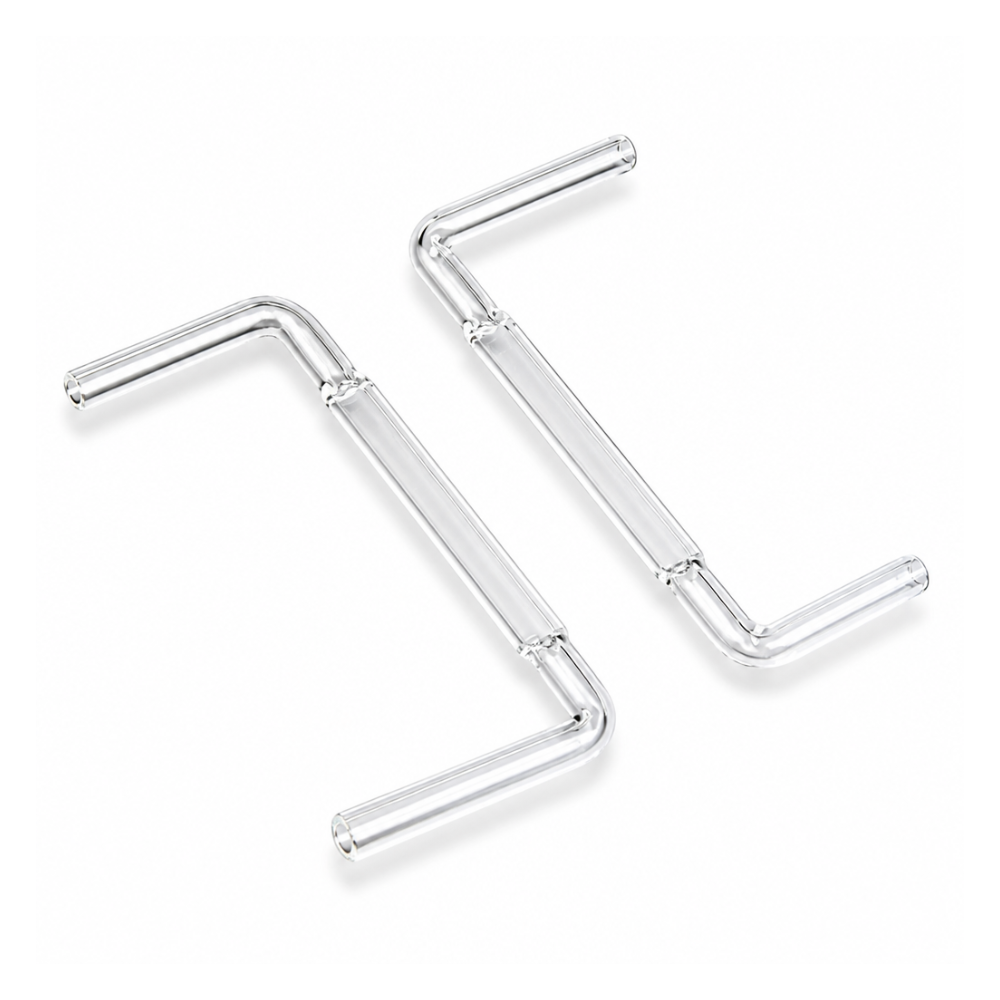
Flow-Through Quartz Cuvette — 0.6 mm Pathlength · 2-Window | CNQFT111
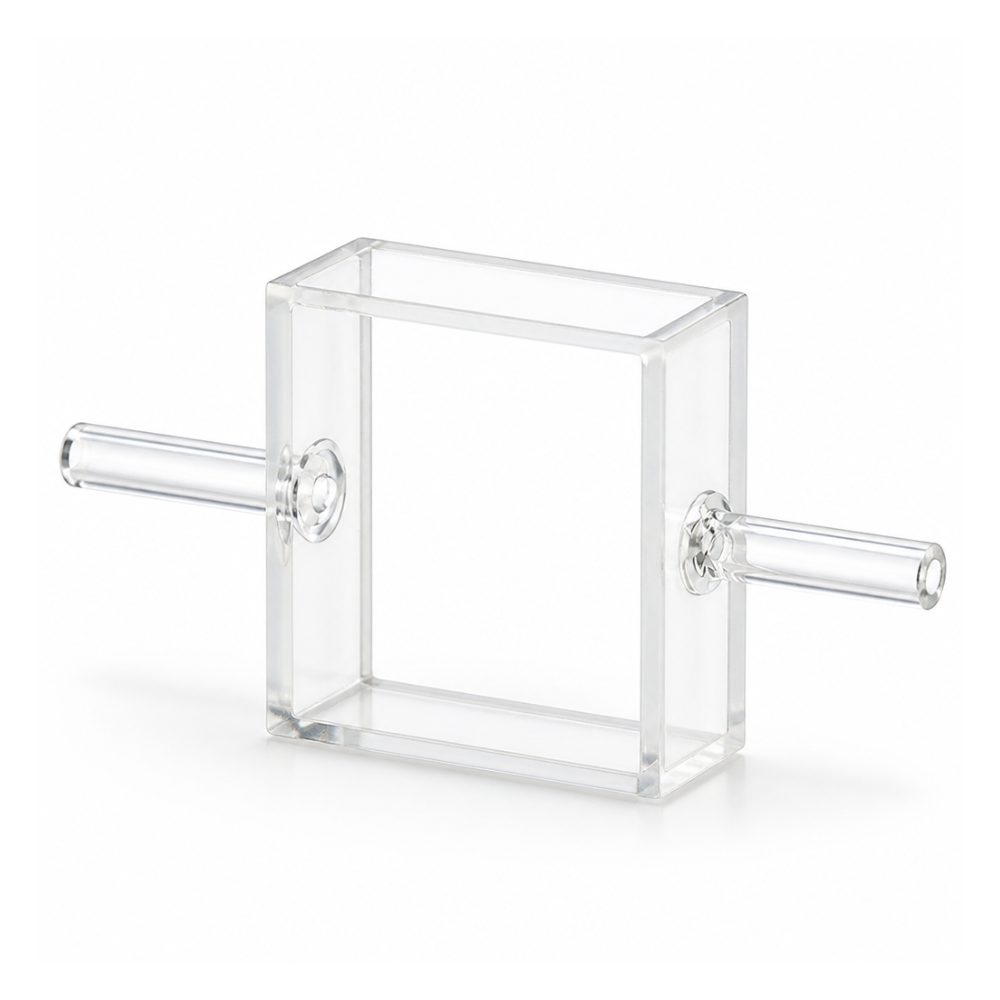
Fluorescence Flow-Through Quartz Cuvette — 10/28 mm Pathlength · 4-Window | CNQFT109
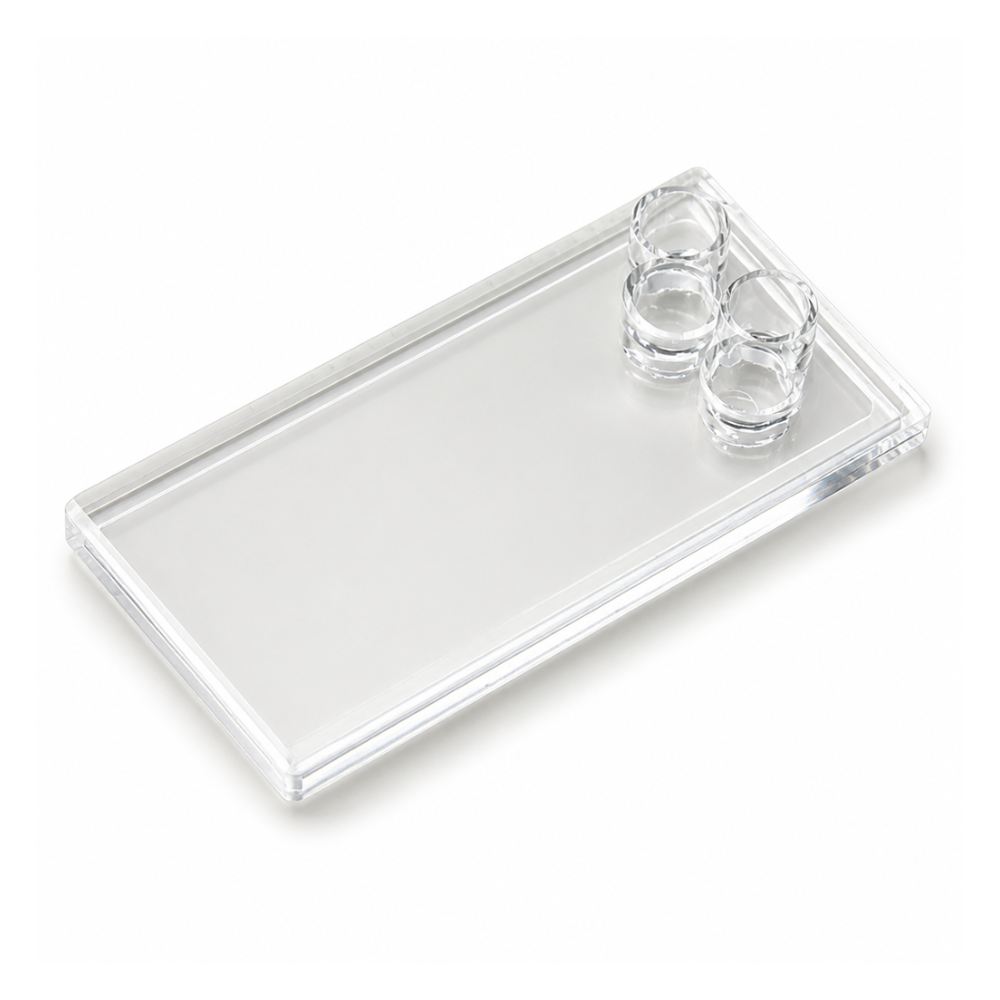
Flow-Through Quartz Cuvette — 0.2 mm Pathlength · 120 uL · Optically Contacted | CNQFT108
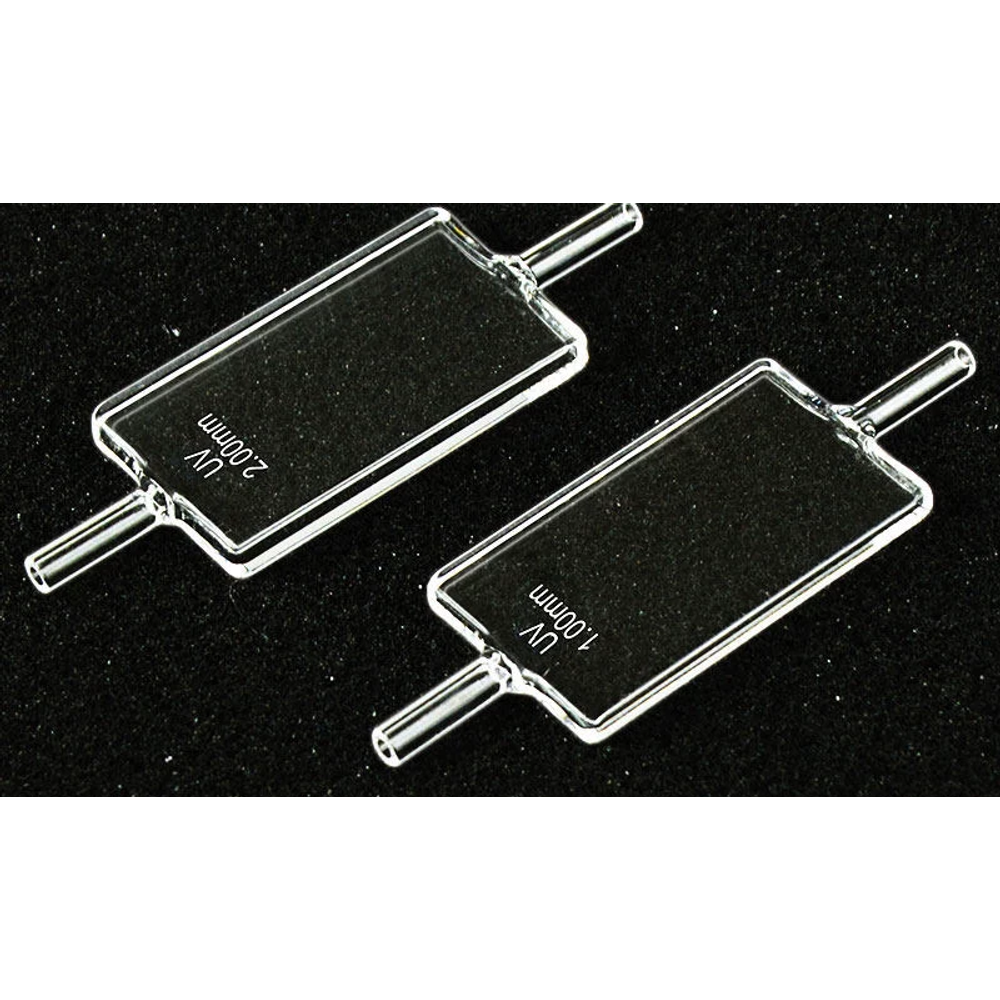
6. Frequently Asked Engineering & Procurement Questions
Can standard quartz spectrophotometer flow cells be connected directly to a 400-bar analytical UHPLC column outlet?
No! Rectangular benchtop quartz cuvette flow cells are engineered for low-pressure continuous flow, peristaltic loops, syringe pumps, and flash chromatography outlets (<= 2 to 3.5 bar / 30–50 psi). Always route high-pressure HPLC effluent through a pressure regulator or post-detector low-pressure waste line.
How do I route 1/16 in. PTFE tubing out of my spectrophotometer without letting room light leak in?
Feed tubing through black santoprene sleeve tubing or use a slotted black anodized feedthrough lid plate; even tiny ambient fluorescent room-light leaks cause 100/120 Hz baseline ripple at high absorbance.
What is the difference between M6 threaded connectors and 1/4"-28 UNF connectors?
M6 x 1.0 mm is the metric chromatography low-pressure standard common on European dissolution/FPLC systems, whereas 1/4"-28 UNF (6.35 mm OD, 0.907 mm pitch) is the North American Upchurch/IDEX standard—never mix nuts across the two thread standards!
How can US and European pharma/academic labs set up Cuvetten for institutional PO payment?
Cuvetten operates under Cotslab Limited (UK Company No. 13153693, IRS Form W-8BEN-E) featuring both a local US domestic USD account at Community Federal Savings Bank (NY, ABA 026073150—$0 cross-border wire fee) and a European EUR SEPA IBAN via /request-a-quote/.
University, National Lab & Corporate PO Fast-Track (Cotslab Limited)
Cuvetten is operated by Cotslab Limited (37 Croydon Road, Beckenham, BR3 4AB, UK · UK Company No. 13153693). U.S. universities and national labs settle USD domestically with $0 international wire fees via Community Federal Savings Bank (New York, ABA Routing 026073150) paired with signed IRS Form W-8BEN-E, while European research groups pay via local EUR SEPA IBAN or Stripe P-Card.
Request Institutional PO Quote / Custom Specs →