
Screw-Cap & PTFE/Silicone Septum-Sealed Quartz Cuvettes for Anaerobic, Air-Sensitive & Volatile Solvent Assays
| Closure Architecture | O2 / Moisture Barrier | Syringe Needle Injection | Heated Peltier Ramp (20–95 C) | Total Cell Height (Check Lid!) | Best Experimental Use Case |
|---|---|---|---|---|---|
| Open-Top GL14 Cap + PTFE/Silicone Septum | High (< ppm O2 drift over 2–4 hr) | YES — pierce directly with 22–26G non-coring needle | Excellent up to 95 C (vent headspace once if volatile) | ~52 – 56 mm | Anaerobic syringe titrations, dithionite reductions, glovebox transfer |
| Closed-Top GL14 Cap + Solid PTFE Liner | Very High (unpierced barrier) | No (unscrew inside glovebox) | Excellent up to 105 C (1–1.5 bar seal) | ~52 – 55 mm | DNA/RNA Tm thermal melting, volatile solvent storage & transport |
| Extended Graded-Seal Schlenk / Young Valve | Ultra-High (all-glass/PTFE high-vac) | Via sidearm or vacuum manifold | High (check tall compartment clearance!) | 85 – 140 mm (requires open/tall lid) | Freeze-pump-thaw degassing for triplet-state phosphorescence |
| Ground-Taper Virgin PTFE Stopper | Moderate (good vapor block, slow O2 creep) | No (pops out under vapor pressure >50 C!) | <= 45 C only (stopper ejects when heated) | ~46 – 48 mm | Room-temp organic UV-Vis/fluorescence without syringe additions |
| Flat Resting PTFE Dust Lid | None (dust baffle only) | Pipette tip access | Evaporative loss > 40 C | 45 – 46 mm | Aqueous room-temp buffer scans < 15 minutes |
1. Dual-Layer PTFE/Silicone Septum Mechanics: Oriented PTFE Side MUST Face the Sample!
Resealable GL14 cuvette septa laminate two complementary elastomers into a single 1.5–3.0 mm disc: a ultra-thin (0.1–0.2 mm) virgin Polytetrafluoroethylene (PTFE) fluoropolymer barrier film bonded onto a resilient, high-purity platinum-cured silicone rubber backing. Pure PTFE resists virtually every organic solvent, strong acid, and organometallic reagent but has zero elastic memory once punctured; pure silicone reseals tightly around a syringe needle but swells violently in toluene, THF, chloroform, and hexane while absorbing hydrophobic dyes.
Always verify septum orientation before threading on the open-top GL14 cap: the smooth, glossy white PTFE face MUST point DOWNWARD toward the quartz neck rim (contacting sample vapor), while the softer matte silicone face points UPWARD against the screw cap! When performing anaerobic titrations outside the glovebox, use a 22-gauge to 25-gauge deflected-point (Huber / non-coring conical tip) Hamilton gas-tight syringe needle—standard flat-bevel hypodermic needles punch out tiny cores of PTFE/silicone that fall into the optical beam and create a permanent gas leak.
2. Glovebox Loading & Headspace Pressure Management During DNA/Protein Thermal Melts (Tm)
Two subtle physical traps catch researchers sealing screw-cap cuvettes inside an Argon or N2 glovebox: first, glovebox antechamber vacuum cycles! NEVER send a sealed liquid-filled screw-cap cuvette into a glovebox vacuum antechamber with the cap tightened—1 bar internal pressure inside a square 1.25 mm wall quartz cell under external vacuum shatters the flat optical windows! Bring empty cuvettes, caps, and septa into the glovebox unsealed, load your deoxygenated sample under 1 atm inert gas, and torque the GL14 cap finger-tight before exiting.
Second, during Peltier-controlled DNA/RNA or protein thermal-denaturation melts from 20 C to 95 C, water vapor pressure rises to 0.84 bar while trapped headspace gas expands by ~25% (total internal gauge pressure ~1.1 bar). Always leave at least 15%–20% compressible gas headspace below the GL14 neck—completely topping off a sealed quartz cuvette with 0% headspace causes incompressible hydraulic liquid expansion (beta_water ~ 4 x 10^-4 /C) that cracks the cell by 50 C!
3. Checking Spectrophotometer Sample-Compartment Lid Clearance (55 mm vs. 45 mm)
While a standard unstoppered cuvette stands 45.0 mm tall, fusing a GL14 threaded glass neck plus screw cap brings overall cell height to 52–58 mm (and up to 65 mm while a syringe needle remains inserted). Almost all modern research benchtop UV-Vis and fluorescence spectrometers (Cary, Shimadzu, Jasco, PerkinElmer, Horiba) provide >= 65–80 mm vertical clearance beneath their hinged dark lid, easily swallowing GL14 screw-cap cells—whereas ultra-compact teaching colorimeters with shallow snap lids should be measured with a ruler first.
4. Pre-Order Engineering & Incoming Laboratory QC Checklist
Before finalizing part numbers for online checkout or submitting a grant requisition, verify these four critical laboratory interface parameters across your experimental bench:
- Size inline flow-cell optical pathlength (0.1–1.0 mm for high-concentration process streams vs. 10–50 mm for trace assays) and verify chamber swept volume <= 10% of minimum chromatographic peak volume.
- Match fluidic inlet/outlet port hardware (Ø3–4 mm quartz hose barbs for < 1.5 bar peristaltic tubing vs. M6 or 1/4"-28 UNF threaded PTFE flangeless fittings) and plumb flow strictly bottom-in, top-out.
- For anaerobic GL14 screw-cap titrations, orient the white virgin-PTFE septum face downward toward sample vapor, leave >= 15% thermal expansion headspace, and pierce with non-coring needles.
- For custom empty atomic vapor and gas absorption cells, specify window wavefront flatness (lambda/4 to lambda/10), anti-etalon wedge angle (0.5–2 deg), and glassblowing stem outer diameter.
5. Featured In-Stock Cuvetten Hardware & Direct Part Numbers
Every stocked part number below ships globally via tracked FedEx International Priority (orders ≥ US$1,800 under 10 kg qualify for $0 free shipping) and supports both instant online Stripe checkout and formal institutional Purchase Orders:
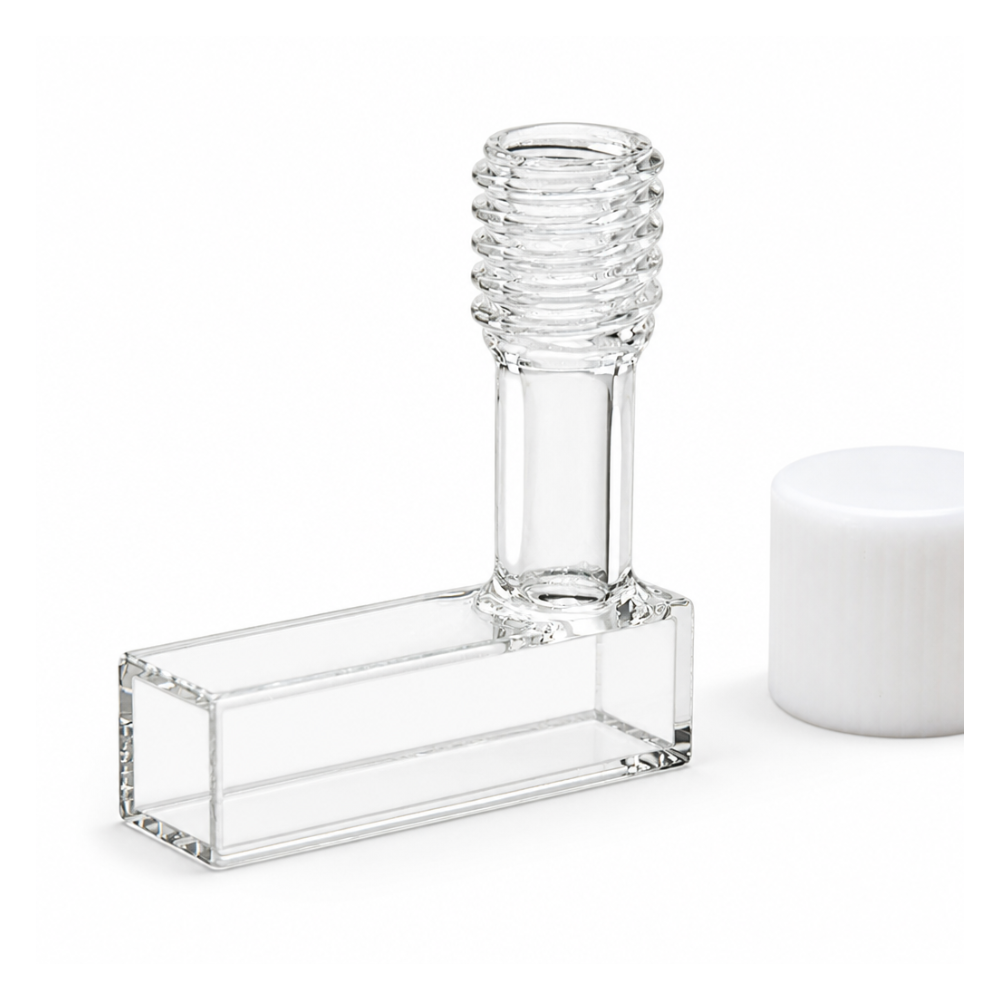
Fluorescence Screw-Top Quartz Cuvette — 40/10 mm Pathlength | CNQST054
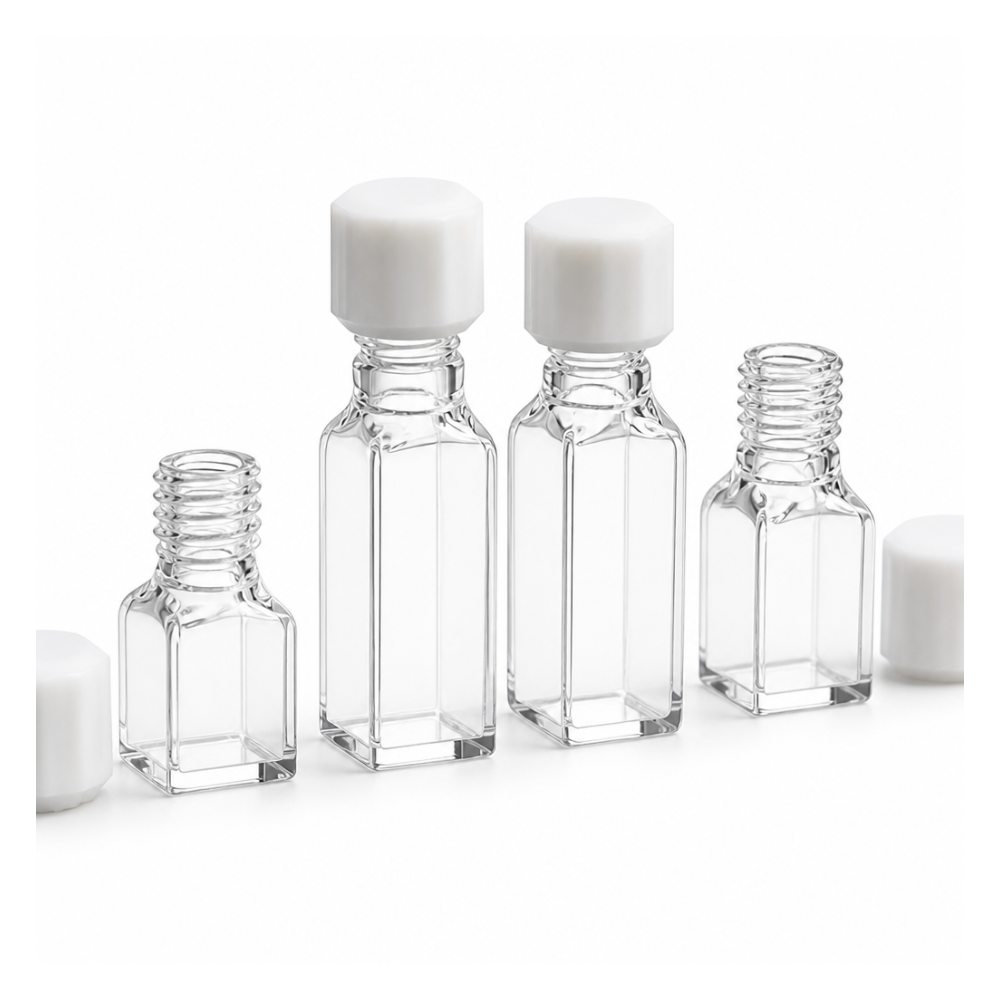
Screw-Top Quartz Cuvette | CNQST052
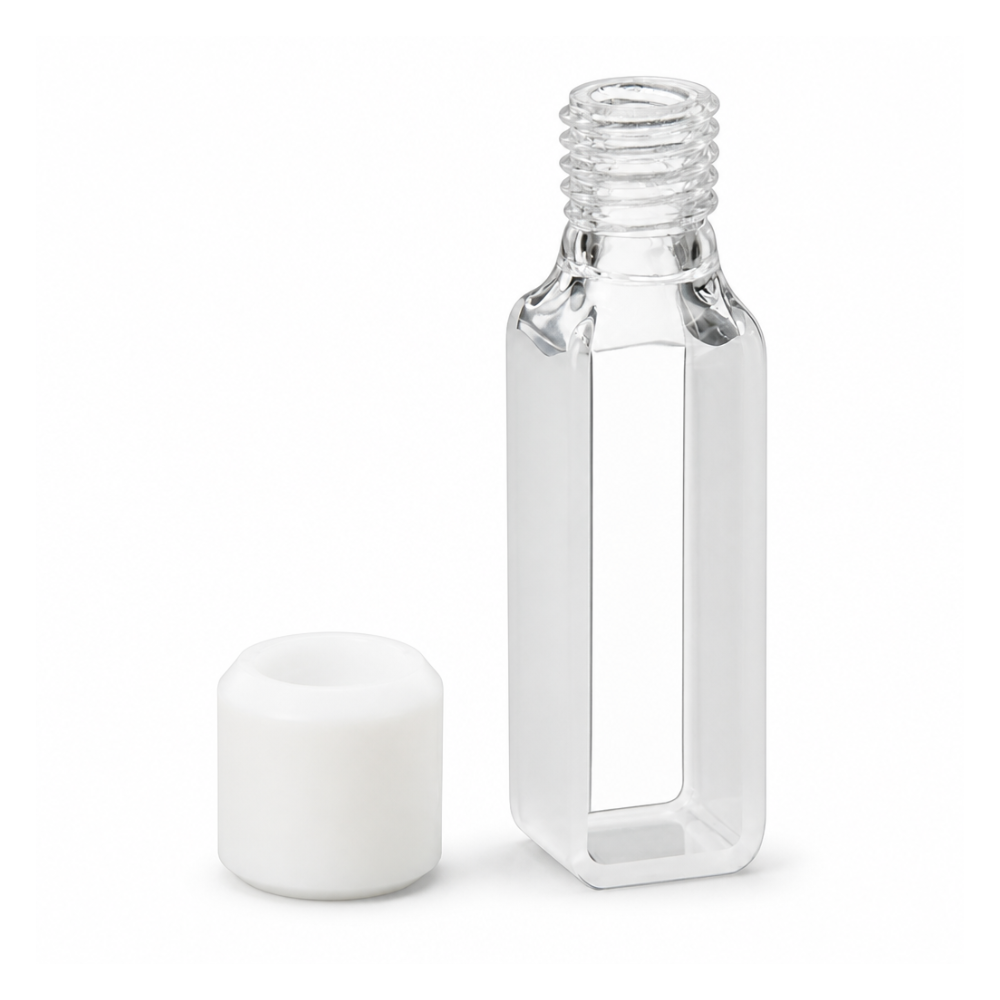
Screw-Top Quartz Cuvette — 10 mm Pathlength · 50 mm Overall Height · 2-Window · With Lid | CNQST051
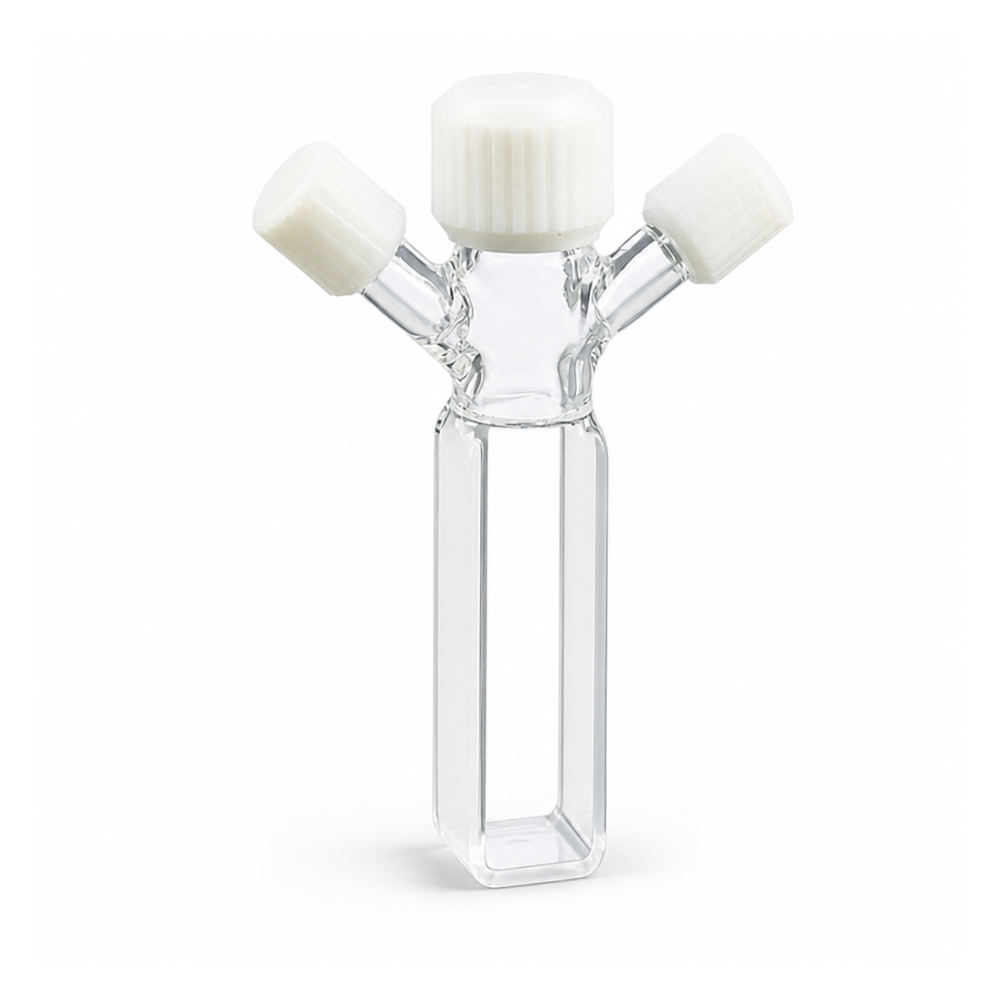
Screw-Top Quartz Cuvette | CNQST053
6. Frequently Asked Engineering & Procurement Questions
How many syringe punctures can a single GL14 PTFE/silicone septum withstand before O2 leaks in?
For strict anaerobic metalloenzyme or radical assays (< 5 ppm O2 tolerance), treat the PTFE barrier as single-run (1 to 3 fine 24G–26G non-coring needle injections within one kinetic experiment) and replace the inexpensive GL14 septum disc before the next experiment.
Can screw-cap quartz cuvettes include a micro magnetic stir bar inside the bottom of the cell?
Yes—10 x 10 mm macro screw-cap cells accommodate Ø2 x 5 mm or Ø2 x 7 mm PTFE-coated micro stir fleas (or dedicated recessed stir-well bases) so injected titrants mix to homogeneity in < 2 seconds without opening the cap.
Are GL14 screw threads universal across laboratory chromatography and vial caps?
Yes! DIN GL14 (14 mm outer glass thread standard) is a universal European/ISO laboratory thread, meaning replacement open-top/closed-top caps and Ø12–13 mm PTFE/silicone septa are globally standardized.
Does Cuvetten offer institutional PO billing with local US USD bank routing?
Yes. Cuvetten operates under Cotslab Limited (UK Company No. 13153693, IRS Form W-8BEN-E) with domestic US USD ACH/Fedwire routing via Community Federal Savings Bank (ABA 026073150, $0 international wire fee) and instant Stripe P-Card payment.
University, National Lab & Corporate PO Fast-Track (Cotslab Limited)
Cuvetten is operated by Cotslab Limited (37 Croydon Road, Beckenham, BR3 4AB, UK · UK Company No. 13153693). U.S. universities and national labs settle USD domestically with $0 international wire fees via Community Federal Savings Bank (New York, ABA Routing 026073150) paired with signed IRS Form W-8BEN-E, while European research groups pay via local EUR SEPA IBAN or Stripe P-Card.
Request Institutional PO Quote / Custom Specs →